In modern CNC systems, end-to-end component design is highly automated using CAD CAM programs. The programs produce a computer file that is interpreted to extract the commands needed to operate a particular machine, and then loaded into the CNC machines for production. Since any particular component might require the use of a number of different tools - drills, saws, etc. - modern machines often combine multiple tools into a single "cell". In other cases, a number of different machines are used with an external controller and human or robotic operators that move the component from machine to machine. In either case the complex series of steps needed to produce any part is highly automated and produces a part that closely matches the original CAD design.
Free CAD-CAM CNC software for mechanical engineering:
G-Simple This CNC program is completely free simple yet powerful software for 3-axis mills, use it to create G-codes for drilling, milling, engraving, tapping & pocketing.
Download:
http://www.polaris.com.gr/gsimple/download.html
GCAM is an free Open Source software for 3-Axis CNC mills. Simple interface for making holes, and sketches, which after extruded, provide the cutting paths for the selected end mill. GCAM also supports RS274X (Gerber) and Excellon drill files for circuit board milling..
Download:
http://gcam.js.cx/index.php/Main_Page
30-day trial versions:
http://www.softsquad.com/downloads.htm
Cut2d by Vectric
Cut2D converts CAD DXF and graphics designs to GCode / CNC Toolpaths for machining high quality parts and components, and users say it's easy to use. Price: $149 .
http://www.vectric.com/WebSite/Vectric/products/download_products.htm
We'll be adding more free cnc software sources as we fin them.
Thursday, April 30, 2009

Friday, February 27, 2009
Flexible Software Delivery Model for CAD Industry. Autodesk
SAN RAFAEL, Calif.,— Autodesk, Inc. a leader in design innovation software and technologies, is adopting a new Flexible Software Delivery model for AutoCAD software, the world's leading customizable and extensible 2D and 3D computer-aided design (CAD) application. Autodesk is the first company in the CAD industry to introduce this new software development and delivery model, which is designed to increase customer satisfaction and subscription value by providing AutoCAD customers with earlier access to new features, delivered on demand, and provide them with the flexibility to choose which features to install and use.
The new Flexible Software Delivery model for AutoCAD consists of two primary components: Subscription Bonus Packs and Product Updates.
Subscription Bonus PacksSubscription Bonus Packs containing new software features are now available to AutoCAD subscription customers through the Autodesk Subscription Center. Subscription customers account for about 75 percent of licensed AutoCAD users. Subscription Bonus Packs will be released regularly and customers will be able to pick and choose which bonus packs to install, providing them greater flexibility in how they deploy their software. AutoCAD customers not on Autodesk Subscription may have access to features from the Subscription Bonus Packs in future product releases. The first AutoCAD 2009 Subscription Bonus Pack, now available for download, provides many useful features that were requested by members of the AUGI (Autodesk User Group International) community.
"Having the option to improve and extend the capabilities of AutoCAD with the use of the Subscription Bonus Pack between full product releases is valuable to our company and is accelerating our ROI," said Keith Rice, CAD Administrator, Pennoni Associates Inc.
Automatic Product UpdatesRelying on critical data from the AutoCAD Customer Involvement Program (CIP) and Customer Error Reporting (CER) utility, Product Updates are now automatically delivered to all licensed AutoCAD customers, providing faster and more regular access to patches and fixes. Read the full story at http://www.machinestogo.net/metal-processing/83-autodesk-first-software-cad-design.html
The new Flexible Software Delivery model for AutoCAD consists of two primary components: Subscription Bonus Packs and Product Updates.
Subscription Bonus PacksSubscription Bonus Packs containing new software features are now available to AutoCAD subscription customers through the Autodesk Subscription Center. Subscription customers account for about 75 percent of licensed AutoCAD users. Subscription Bonus Packs will be released regularly and customers will be able to pick and choose which bonus packs to install, providing them greater flexibility in how they deploy their software. AutoCAD customers not on Autodesk Subscription may have access to features from the Subscription Bonus Packs in future product releases. The first AutoCAD 2009 Subscription Bonus Pack, now available for download, provides many useful features that were requested by members of the AUGI (Autodesk User Group International) community.
"Having the option to improve and extend the capabilities of AutoCAD with the use of the Subscription Bonus Pack between full product releases is valuable to our company and is accelerating our ROI," said Keith Rice, CAD Administrator, Pennoni Associates Inc.
Automatic Product UpdatesRelying on critical data from the AutoCAD Customer Involvement Program (CIP) and Customer Error Reporting (CER) utility, Product Updates are now automatically delivered to all licensed AutoCAD customers, providing faster and more regular access to patches and fixes. Read the full story at http://www.machinestogo.net/metal-processing/83-autodesk-first-software-cad-design.html
Thursday, January 29, 2009
Mitsubishi VZ1 and VZ2 Series 3-dimensional laser cutting systems

Mitsubishi’s VZ Series: High-Performance Tools for Maximum Productivity
Mitsubishi’s VZ1 and VZ2 Series, 3-dimensional laser cutting systems offer the ultimate in accuracy and flexibility for users across a wide range of complex laser applications. The unique flexibility of these 5- and 6-axis systems, combined with expanded teaching functions and Mitsubishi’s superior resonator technology, make them extremely powerful tools. They significantly decrease the time and manpower required to produce complex parts, and provide the greatest degree of accuracy and cost efficiency.
The VZ Series Machines feature:
Mitsubishi’s Patented 3-Axis Cross Flow Resonator for superior cutting power
Digital Rectangular Wave High-Peak Power Pulse delivers increased cutting power and cleaner edge quality
Enhanced LC20T Control system with Windows CE and 64-bit CNC. New World Class LC20T 64-bit Control SystemA major key to the enhanced performance of the VZ series is the new LC20T control system. Equipped with a 64-bit Windows based high-speed NC and highly advanced PC-based teach pendant using Windows CE, the LC20T gives the user a powerful and easy-to-use interface. The result is maximum speed and flexibility during programming, job setup, or parts cutting.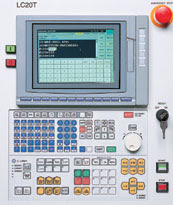 Industry's most advanced PC-based teach pendant for maximum programming power and flexibility.
2GB Hard drive capacity can handle large programs up to 16,000,000 points
Easy One-Touch teach functions dramatically reduce keystrokes during manual programming - up to 50%
Optional DiamondSoft 3D CAD/CAM software for easy to use, advanced offline programming capability.
Powerful and easy to use material parameter tables
Bi-directional offset to zero-offset data conversion
Mitsubishi’s VZ1 and VZ2 Series, 3-dimensional laser cutting systems offer the ultimate in accuracy and flexibility for users across a wide range of complex laser applications. The unique flexibility of these 5- and 6-axis systems, combined with expanded teaching functions and Mitsubishi’s superior resonator technology, make them extremely powerful tools. They significantly decrease the time and manpower required to produce complex parts, and provide the greatest degree of accuracy and cost efficiency.
The VZ Series Machines feature:
Mitsubishi’s Patented 3-Axis Cross Flow Resonator for superior cutting power
Digital Rectangular Wave High-Peak Power Pulse delivers increased cutting power and cleaner edge quality
Enhanced LC20T Control system with Windows CE and 64-bit CNC. New World Class LC20T 64-bit Control SystemA major key to the enhanced performance of the VZ series is the new LC20T control system. Equipped with a 64-bit Windows based high-speed NC and highly advanced PC-based teach pendant using Windows CE, the LC20T gives the user a powerful and easy-to-use interface. The result is maximum speed and flexibility during programming, job setup, or parts cutting.
Industry's most advanced PC-based teach pendant for maximum programming power and flexibility.2GB Hard drive capacity can handle large programs up to 16,000,000 points
Easy One-Touch teach functions dramatically reduce keystrokes during manual programming - up to 50%
Optional DiamondSoft 3D CAD/CAM software for easy to use, advanced offline programming capability.
Powerful and easy to use material parameter tables
Bi-directional offset to zero-offset data conversion
Wednesday, January 28, 2009
Mazak Launches Online Parts Ordering (CNC technology)
Florence, Kentucky, January 20, 2009 – Mazak Corporation has added a new capability to its website to allow customers to place and review orders for spare parts via the Internet. With an interface similar to those found on major retailers’ websites, customers can view past orders and track the shipping progress of current orders. Through the ability to search for parts by part number or description, customers can also easily peruse the catalog of over 46,000 unique part numbers that are shipped from Mazak’s North American Parts Center in Florence, Kentucky. Additionally, price and availability of each part can be viewed through the online parts system.
“We’ve been in the process of updating our parts operations over the past several years,” says Steve Trammel, North American Parts Center Manager. “Establishing a comprehensive, user-friendly web presence is a natural extension of that evolution. When customers place an order on our website, they receive a UPS or FedEx tracking number by email so that they can follow the progress of their shipment.”
Mazak maintains over $60 million in parts inventory and achieves same-day shipping on 97.5% of orders placed. Responsible for supporting the whole of the company’s North and South American customer base, the parts center fulfills over 1,000 orders per day, ranging from light bulbs, bearings and switches, all the way up to spindles, ball screws and linear guides.
Mazak’s parts website can be found at https://parts.mazakcorp.com. Parts inquiries and orders may also be made via email at pparts@mazakcorp.com, telephone at 888-462-9251 or fax at 859-342-1350.
“We’ve been in the process of updating our parts operations over the past several years,” says Steve Trammel, North American Parts Center Manager. “Establishing a comprehensive, user-friendly web presence is a natural extension of that evolution. When customers place an order on our website, they receive a UPS or FedEx tracking number by email so that they can follow the progress of their shipment.”
Mazak maintains over $60 million in parts inventory and achieves same-day shipping on 97.5% of orders placed. Responsible for supporting the whole of the company’s North and South American customer base, the parts center fulfills over 1,000 orders per day, ranging from light bulbs, bearings and switches, all the way up to spindles, ball screws and linear guides.
Mazak’s parts website can be found at https://parts.mazakcorp.com. Parts inquiries and orders may also be made via email at pparts@mazakcorp.com, telephone at 888-462-9251 or fax at 859-342-1350.
Tuesday, December 30, 2008
New Mini Mill 2 Extended Travels from Haas Automation
 |
| From CNC Machines |
When Haas introduced the Mini Mill in 2000, it quickly became one of the best selling machines in the company’s history. Its combination of small footprint, full CNC capabilities and sub $30K price were unheard of in the industry. The Super Mini Mill added even more capabilities, while maintaining the same compact footprint and affordability. But sometimes you just need a little more travel. For 2008, Haas introduces the Mini Mill 2, a versatile CNC machining center with all the attractive features of the original Haas Mini Mill, but with extended travels of 20" x 16" x 14" (xyz) – a 4" increase on each axis. The Mini Mill 2 features a standard 40-taper spindle that spins to 6,000 rpm. It is powered by a 7.5-hp vector drive system. The 40" x 14" T-slot table provides plenty of room for multiple fixtures or a single- or dual-axis rotary table. Rapids are 600 ipm, with 500-ipm cutting feeds. Standard equipment includes a 15" color LCD monitor with USB port, a 10-pocket carousel-style tool changer and 1 MB of program memory. For shops needing more tools, the Mini Mill 2 has options for either a 20-pocket carousel tool changer or a 24+1 tool side-mount. Other options include 4th- and 5th-axis drives, a programmable coolant nozzle, high-speed machining software, Haas’ Intuitive Programming system, a chip auger and more.The new Super Mini Mill 2, which will be available later this year, has the same travels as the MM2, but offers higher speeds and feeds, and more available options. It will come standard with a 10,000-rpm 40-taper spindle, a 15-hp vector drive system, a high-speed tool changer and 1,200-ipm rapids. A coolant system and rigid tapping are also standard. High-productivity options for the Super Mini Mill 2 include a 15,000-rpm spindle, a high-speed 24+1 tool side-mount tool changer, through-spindle coolant, 4th- and 5th-axis drives and more.Built in the USA by Haas, the new Mini Mill 2 and Super Mini Mill 2 are backed by the worldwide network of Haas Factory Outlets – the most extensive system of support and service in the industry.
Thursday, December 11, 2008
WaterJet Cutting - Granite Bridge Saw

In 21st century’s industrialized world, the machines like CNC Machines, Water-jet Cutting machines and Granite Bridge Saw are getting very trendy. These are some of the rapid emergent methods to cut materials having benefits like most effectual, cost effective and easy to operate. One of the new emerging technologies in metal industry is CNC Machines. The prologue of CNC (Computer Numerical Control) machines has made an immense impact on the manufacturing mechanized industry. CNC machines can assist individuals to cut curves as a straight line; Complex 3-D structure can be created and thus abridged the human actions. Thus these machines are giving credit to CNC Shop for getting so trendy and helpful to mankind. It provides the manufacture to produce more flexibility in holding the parts while manufacturing and to alter the machine to produce different modules. CNC machine consists of milling, grinding, polishing and sculpting functions. It is particularly suitable for creating high grade basin plank and other abnormal products. Normally made from stone, ceramic, glass and micro-crystal stone. The machine will automatically terminate the processing of any requisite profile by effortless setting. The products are of elevated accuracy and good glossiness rate. Water jet cutting is the other pattern of same type of tool, which is proficient of slicing into metal or substances with high velocity and pressure. Mostly used for the fabrication and manufacture of components for machinery and some other devices. Water jets are used to cut materials as assorted as fish-sticks, 'gas-station' sandwiches, and titanium. Tranquilly there are few components which cannot be efficiently cut with a water jet cutter such as, tempered-glass, which smashes when cut, despite of the cutting technologies which are used. Water jet cutting technology is the most proficient, cost effectual and fastest mounting method to cut components. Due to its flexibility and ease to operate, fabricators rapidly comprehend the enormous potential of these machines. Water jets (or abrasive jets) can cut virtually any component having any shape with no heat deformation or mechanical pressure usually caused by other methods. Another tool which is getting very valuable position in manufacturing industrial use is Granite Bridge Saw. Bridge Saws also comprise different assortment for the diverse principles in Small laboratories or manufacturing industries such as Marble and granite bridge cutter, diamond saw machine into rails, electronic bridge shape sawing machine, Compactness and sturdiness etc. These tools help businesses and populace to execute hundreds of reinstatement and refinishing projects, both large and small. Companies can reinstate many damaged marble statues and stonework, in numerous cases masking any evidence of damage.
More info at: www.marbleservices.com
Sunday, November 23, 2008
Human-Product Interactions CAD CAM CAE Software

Two tools, Pro/ENGINEER Manikin Extension helps designers see and analyze interactions between people, products, and work stations. At the other hand: Using the Pro/ENGINEER Manikin Analysis Extension, designers can simulate and analyze human-product interactions such as pushing and pulling.
NEEDHAM, MA. - November 11, 2008 -PTC® (Nasdaq: PMTC), The Product Development Company®, announced the launch of Pro/ENGINEER® ManikinTM, a 3D digital human modeling solution that enables design teams to add a digital human model to a CAD product model to simulate and communicate human-product interactions. The Two new modules, Pro/ENGINEER Manikin Extension and Pro/ENGINEER Manikin Analysis Extension, provide ergonomic and human factors analysis capabilities for customers of Pro/ENGINEER, PTC's parametric 3D CAD/CAM/CAE software and a key component of the PTC® Product Development System. By accelerating detailed design processes and reducing the need for expensive physical prototypes, Pro/ENGINEER Manikin helps customers create innovative, winning products with faster time-to-market, improved quality and reduced costs.
"PTC's new manikin software is notable for its tight integration with Pro/ENGINEER. Pro/ENGINEER Manikin brings digital human visualization and simulation to the engineer's desktop within the CAD user interface and without the need for the engineer to be a human factors expert," said John MacKrell, senior analyst, CIMdata. "This is a very impressive first step for PTC for supporting a human-centric design approach. Pro/ENGINEER Manikin will enable customers to better optimize their products for the people who will use, manufacture and maintain them"
Pro/ENGINEER Manikin, the industry's first ISO standards-based solution, provides comprehensive, easy-to-use, capabilities to simulate and communicate human-product interactions for a global population. Highlights of Pro/ENGINEER Manikin Extension and Pro/ENGINEER Manikin Analysis Extension include:
Pro/ENGINEER Manikin Extension
Quickly insert, customize, and manipulate accurate, standards-based 3D human models.
Create human reach envelopes and vision cones to understand what limitations may exist in a design.
Gain a first-person perspective of a product and "see" what the manikin can "see".
Accelerate design by leveraging libraries of global populations and manikin postures.
Pro/ENGINEER Manikin Analysis Extension
Simulate, communicate and optimize manual handling tasks by validating them against published standards and guidelines.
Simulate, communicate and optimize manual handling tasks by validating them against published standards and guidelines.
Ensure conformance with health and safety guidelines and ergonomic standards. Includes standard algorithms for analyzing workplace tasks including lifting and lowering (NIOSH 81/91), pulling and pushing (Snook), energy expenditure (GARG), and posture (RULA).
Analyze designs faster with simplified workflows to posture the manikin and reuse saved postures and analysis settings.
Leverage advanced reporting capabilities of analysis results earlier in the development process to deliver products designed and optimized for humans in less time.
Additionally, beginning in December 2008, basic manikin capabilities that enable users to insert a pre-defined manikin into a CAD model and easily manipulate the posture to gain an understanding of how a human would fit or interact with a proposed design will be included in all Pro/ENGINEER packages at no additional charge for those customers on the latest maintenance release of Pro/ENGINEER Wildfire 4.0.
The importance of this product is that early lifecycle visualization, simulation and communication reduces development costs, shortens time to market.
More info at:
http://www.ptc.com
http://www.ptc.com
Tuesday, November 18, 2008
The New Dual table CNC by Milltronics

“Keep your CNC operator busy every moment”. Based in this concept Milltronics Manufacturing Company has increased up production on its newly designed Dual or Twin Table TT Series machining centers to meet the increasing customer demands.
This unique CNC machine design offers two separate work tables that shuttle outside the working area for convenient part loading while the opposite work table is inside the machining enclosure cutting parts. Finished the machining operation, the individual work tables shuttle the completed parts out and the next table enters the work area for machining, creating a non-stop machining cycle.
The rigid cast iron bridge design of the TT24 and TT40 CNC machines utilizes a single set of linear ball or roller ways with independent ball screws and axes motors for table control providing superior accuracy and cutting performance. Enhancement of the TT's cutting performance is provided through an Inline spindle, available standard at 10,000 RPM or optional 15,000 RPM. With 1600 IPM rapid traverse rates on the TT24 and TT40, high RPMs, high speed double arm ATC on the TT24 and TT40, plus the elimination of spindle down time for part loading typical of conventional machining centers, the TT CNC Series raises a new meaning to Lean Manufacturing.
These machines are available in three sizes, the TT24 with a 24" square work envelope, the TT40 with a 40" square work envelope, and the TT60 with twin 60x80" tables, the TT Series machines deliver a new level of cost effective machining to small and large shops alike.
These are some TT24’s characteristics or features according to Milltronics:
-Fully integrated twin pallet machine with a unique design requiring no pallet removal
-Conversational programming with Milltronics CNC control
-Inline spindle design – 24 HP standard with 35 HP option
-Reduced cycle times due to no part loading time
-100% cast iron design with 10,000 lb machine weight
-1600 ipm rapids
-24 pocket tool changer standard
-Large memories for part storage and execution
-Ground ball screw construction
True encoder positioning feedback
-Graphic program verification
-No leaning into the machine!
-No doors to open and close!
-No time lost changing parts!
-Accurate time management
-Superior chip and coolant control
-Designed and built by American craftsmen.
This unique CNC machine design offers two separate work tables that shuttle outside the working area for convenient part loading while the opposite work table is inside the machining enclosure cutting parts. Finished the machining operation, the individual work tables shuttle the completed parts out and the next table enters the work area for machining, creating a non-stop machining cycle.
The rigid cast iron bridge design of the TT24 and TT40 CNC machines utilizes a single set of linear ball or roller ways with independent ball screws and axes motors for table control providing superior accuracy and cutting performance. Enhancement of the TT's cutting performance is provided through an Inline spindle, available standard at 10,000 RPM or optional 15,000 RPM. With 1600 IPM rapid traverse rates on the TT24 and TT40, high RPMs, high speed double arm ATC on the TT24 and TT40, plus the elimination of spindle down time for part loading typical of conventional machining centers, the TT CNC Series raises a new meaning to Lean Manufacturing.
These machines are available in three sizes, the TT24 with a 24" square work envelope, the TT40 with a 40" square work envelope, and the TT60 with twin 60x80" tables, the TT Series machines deliver a new level of cost effective machining to small and large shops alike.
These are some TT24’s characteristics or features according to Milltronics:
-Fully integrated twin pallet machine with a unique design requiring no pallet removal
-Conversational programming with Milltronics CNC control
-Inline spindle design – 24 HP standard with 35 HP option
-Reduced cycle times due to no part loading time
-100% cast iron design with 10,000 lb machine weight
-1600 ipm rapids
-24 pocket tool changer standard
-Large memories for part storage and execution
-Ground ball screw construction
True encoder positioning feedback
-Graphic program verification
-No leaning into the machine!
-No doors to open and close!
-No time lost changing parts!
-Accurate time management
-Superior chip and coolant control
-Designed and built by American craftsmen.
Wednesday, November 12, 2008
Wood Working

Though working with metals was the big gate at first for the new CNC technology lately, the CNC machines has been taking a real place not only in production of industrial mechanical parts but even carving complex fine art parts in different materials such plastics, glass, wood, etc. This picture is a clear and simple example of how a machine (CNC router) following a CAD software has produced an artistic work in wood carving the wheels inclusive.
Thursday, May 22, 2008
Multi-axis Machine for Mass Production

It's called "The Pinnacle of Mass-Production". Up to 3 turrets can be installed, all of them Built-in Motor Turret (BMT™). By placing the motor inside the turret, heat generation and vibration are reduced to a minimum and transmission efficiency is improved. Cutting performance, speed and precision are also increased. The previous model worked with a transmission structure with many heat-generating parts such as gears and belts, which affect machining accuracy, but the new nz series tourret works with a built-in motor, there is no transmission structure. The sources of heat are reduced, and the motor is also surrounded by a cooling jacket.

The new NZ Series of cnc multi-axis machines offers not only turning, but also excellent milling with the Y-axis. With the longest Y-axis stroke in its class, it achieves high-precision, high-efficiency machining.
Mori Seiki's original technology, the Octagonal Ram Construction (ORC™), is a fundamental improvement on the weaknesses of conventional moving structures. With the symmetry of an octagonal shape, thermal displacement is controlled and stable straightness is ensured even at high speeds. It offers stable, high-precision machining.

The cnc's engeniers had achieved both high flexural rigidity and a light body by making repeated use of the most advanced analytical techniques. They've used Finite Element Method (FEM) analysis to simulate the structure's deformation under load. By making fine adjustments to every detail, from the thickness of the bed to the shape and arrangement of the ribs, they achieved high fl exural rigidity. At the same time, we managed to make the body light.
From Moriseiki's official website.
http://www.moriseiki.co.jp
Saturday, March 1, 2008
For Aerospace Production, Integrex e-Ramtec V8
 The INTEGREX e-RAMTEC V/8 is doted with a ram spindle, whose cutting heads are automatically changed by the ATC to do deep I.D. turning and I.D. angle head drilling.
This CNC machinig center was disigned for aircraft, ships, construction machinery and other large items to vertical lathe-based development of complex machining, in addition to the usual set up a dedicated spindle machining diameter of the shaft so that the diameter can not change tooling for processing.
The axis distance reach 900 MM and has a 40 collection tools, performing a long time task, along with the cars and milling function.
There is no need to change the tooling, which minimize the processing time for instance before you'd needed 1oo hours of processing now you only need 12 hours to complete a mechanical task and the precision has increades as well.
This smart machine can detect thermal deformation and prevent mechanical interference, can inspect the center of gravity position.
Saturday, January 19, 2008
CNC CAD CAM software

CNC software is probably cnc's most important tool or resource.
Just was released Mastercam’s Maintenance that delivers enhanced toolpath control
CNC Software releasing the second Maintenance release for Mastercam X2 and CNC Software announces the release of MR2 Mastercam X2’s Maintenance Release. This release introduces significant new capabilities, including new and improved toolpaths for high speed machining, multiaxis enhancements, and much more.
Multiaxis Enhancements
Some powerful enhancements are included in the advanced multiaxis toolpaths. For example, allows the toolpath motion to be optimized by completing one region before moving on to another, and expanded entry and exit macros that greatly simplify contacting and leaving the material.
Peel Milling Toolpath
Delivers powerful high speed cutting to 2D projects, this new toolpath moves the tool in and “peels” away material, layer by layer.
Operations Manager
The Ccam Operations Manager panel can float to a different area of the graphics window or to a separate screen when you are working with dual monitors.
Creating a Boundary Function
The Create Boundary function greatly expands cad Mastercam’s toolpath boundary creation, restricting the toolpath to highly specific areas. It can calculate the boundary using shallow areas, theoretical rest areas, cutter contact areas, and enhanced silhouette boundary controls and more.
Swept Surfaces
New techniques and options have been added more sweep orientation control options, greater flexibility in the use of multiple along and cross curves.
MR2 Enhancements
You can now define horizontal block drill stations in the machine definition rather than using an aggregate, set up different views for each station.
Common edge optimization in nesting is now supported. Nesting toolpaths so that they have common edges saves both time and money.
At the Level Manager can now be moved to a second monitor and left open. You can also hide all geometry except what is on the main level, or display a range of levels in the Level Manager grid.
Donload de last CNC software
cad cam, free cnc software, cnc programming software, cnc software, cnc router software, cnc control software, cam
Thursday, April 19, 2007
CNC machinery and tools

A CNC machine tool is a powered mechanical device used to fabricate metal components of machines by the selective removal of metal. The term machine tool is usually reserved for tools that used a power source other than human movement, but they can be powered by people if appropriately set up. Many historians of technology consider that the true machine tools were born when direct human involvement was removed from the shaping or stamping process of the different kinds of tools. For instance, they consider that lathe machine tools were invented around 1751 by Jacques de Vaucanson because he was the first to mount the cutting instrument on a mechanically adjustable head, taking it out of the hands of the operator.
Related equipment and machinery: CNC vertical machining center, cnc horizontal machining center, CNC turning center, CNC rotary table and indexers, Automation Production and manufacturing, Stewart platform, Drills, EDMs, Lathes, Milling machines, Wood routers , Sheet metal works Hot-wire foam cutters Plasma cuttings Water jet cutters Laser cutting Oxy-fuel CNC turning centers, vertical machining centers, horizontal machining centers, Multi-Tasking machines, 5-axis machines mill drill CNC VMC technology HMC rotary tables CAD CAM lathes, vertical horizontal machine tools, 5-axis, cnc magazine, computer numerical control, mold machine, toolroom mill FMS, gantry, pallet changer, trunnion, spindle, g-code, metalcutting, metalworking, milling machines, Collet lathes, machine tools, mill, milling center, indexer, rotary, machinery, automation. cnc router. wood cnc router. table top cnc router. plastic cnc router. low cost cnc router. cnc router video. cnc video. cnc router pics. cnc router images. video of cnc router. cnc router images. CAD CAM software. cnc plasma. cnc router control. cnc router table. cnc router cutting. cnc router in USA. small cnc router. cnc router machines. cnc router for milling. Guitar making cnc. artcam. cnc wax. cnc router for wax. cnc routers for jewelry. cnc routers for rings. cnc routers 4th axis. cnc routers servo. cnc routers steppers. cnc routers for aluminum. cnc routers for brass. cnc plasmas for metals. cnc plasmas with hypertherm. cabinet cnc routers mdf cnc routers computer numeric controlled computer milling computer aided designing computer aided machining machining was cnc numeric control linear motion Vector Art for cnc Relief Aat for cnc
Related equipment and machinery: CNC vertical machining center, cnc horizontal machining center, CNC turning center, CNC rotary table and indexers, Automation Production and manufacturing, Stewart platform, Drills, EDMs, Lathes, Milling machines, Wood routers , Sheet metal works Hot-wire foam cutters Plasma cuttings Water jet cutters Laser cutting Oxy-fuel CNC turning centers, vertical machining centers, horizontal machining centers, Multi-Tasking machines, 5-axis machines mill drill CNC VMC technology HMC rotary tables CAD CAM lathes, vertical horizontal machine tools, 5-axis, cnc magazine, computer numerical control, mold machine, toolroom mill FMS, gantry, pallet changer, trunnion, spindle, g-code, metalcutting, metalworking, milling machines, Collet lathes, machine tools, mill, milling center, indexer, rotary, machinery, automation. cnc router. wood cnc router. table top cnc router. plastic cnc router. low cost cnc router. cnc router video. cnc video. cnc router pics. cnc router images. video of cnc router. cnc router images. CAD CAM software. cnc plasma. cnc router control. cnc router table. cnc router cutting. cnc router in USA. small cnc router. cnc router machines. cnc router for milling. Guitar making cnc. artcam. cnc wax. cnc router for wax. cnc routers for jewelry. cnc routers for rings. cnc routers 4th axis. cnc routers servo. cnc routers steppers. cnc routers for aluminum. cnc routers for brass. cnc plasmas for metals. cnc plasmas with hypertherm. cabinet cnc routers mdf cnc routers computer numeric controlled computer milling computer aided designing computer aided machining machining was cnc numeric control linear motion Vector Art for cnc Relief Aat for cnc
Blogs Directory
CNC Routers

A router is a woodworking tool used to rout out (hollow out) an area in the face of a piece of wood. It was a tool particularly used by pattern makers and staircase makers and consisted of a broad-based wooden hand plane with a narrow blade projecting well beyond its base plate gaining it the nickname Old Woman's Tooth. Since about 1960, it has been replaced by the modern spindle router, which was designed for the same work, although the first electric hand routers appeared in the years just after World War I. Further refinement produced the plunge router, invented by Elu (now part of deWalt) in Germany in the late 1940s. This is even better adapted for many types of work. Today, traditional hand-powered routers are often called router planes. Modern routers are often used in place of traditional moulding planes or spindle moulder machines for edge decoration (moulding) of timber. Related to the router, is a smaller lighter version designed specifically for trimming laminates. It can be used for smaller general routing work. For example with an appropriate jig it can be used recessing door hinges and recessing lock faceplates etc. A wood CNC Router is similar to a metal CNC mill with the following differences:The wood router typically spins faster — up to 24,000 RPM It typically uses smaller tools — typical shank size 20 mm or at most 25 mm. It typically uses smaller toolholders MK2 (Morse taper #2 - on older machines),ISO-30, HSK-63 or the tools just get held in a collet tool holder affixed directly to the spindle nose. ISO-30 and HSK-63 are rapid-change toolholding systems. HSK-63 has begun to supplant the ISO-30 as the rapid change standard in recent years Some wood routers have multiple separate heads that can come down simultaneously or not. This design is generally not as easy as a toolchanger with ISO-30 or HSK-63, though it is easier to maintain. A wood router table is controlled in the same way as a metal mill, but there is a lot of CAM software specifically for wood routers. Wood with different grain must be approached with unique strategies, and wood CAM software is less likely to need to have hog-out strategies than the metal ones. Wood routers are frequently used to machine other soft materials such as plastics at high speed.
CNC Milling machine

A milling machine is a machine tool used for the complex shaping of metal and other solid materials. Its basic form is that of a rotating cutter or endmill which rotates about the spindle axis (similar to a drill), and a movable table to which the workpiece is affixed. That is to say the cutting tool generally remains stationary (except for its rotation) while the workpiece moves to accomplish the cutting action. Milling machines may be operated manually or under computer numerical control (see CNC). Milling machines can perform a vast number of complex operations, such as slot cutting, planing, drilling, rebating, routing, etc. Cutting fluid is often pumped to the cutting site to cool and lubricate the cut, and to sluice away the resulting swarf.
There are two main types of mill: the vertical mill and the horizontal mill. In the vertical mill the spindle axis is vertically oriented. Milling cutters are held in the spindle and rotate on its axis. The spindle can generally be extended (or the table can be raised/lowered, giving the same effect), allowing plunge cuts and drilling. There are two subcategories of vertical mills: the bedmill and the turret mill. In a turret mill the spindle remains stationary during cutting operations and the table is moved both perpendicular to and parallel to the spindle axis to accomplish cutting. In the bedmill, however, the table moves only perpendicular to the spindle's axis, while the spindle itself moves parallel to its own axis. Also of note is a lighter machine, called a mill-drill. It is quite popular with hobbyists, due to its small size and lower price. These are frequently of lower quality than other types of machines, however.
Most CNC milling machines or machining centers are computer controlled vertical mills with the ability to move the spindle vertically along the Z-axis. This extra degree of freedom permits their use in engraving applications, and also allows to create 2.5D surfaces such as relief sculptures. When combined with the use of conical tools or a ball nose cutter, it also significantly improves milling precision without impacting speed, providing a cost-efficient alternative to most flat-surface hand-engraving work.
CNC lathes

CNC Lathe and turningCNC lathes are rapidly replacing the older production lathes (multispindle, etc) due to their ease of setting and operation. They are designed to use modern carbide tooling and fully utilize modern processes. The part may be designed by the Computer-aided manufacturing (CAM) process, the resulting file uploaded to the machine, and once set and trialled the machine will continue to turn out parts under the occasional supervision of an operator. The machine is controlled electronically via a computer menu style interface, the program may be modified and displayed at the machine, along with a simulated view of the process. The setter/operator needs a high level of skill to perform the process, however the knowledge base is broader compared to the older production machines where intimate knowledge of each machine was considered essential. These machines are often set and operated by the same person, where the operator will supervise a small number of machines (cell). The design of a CNC lathe has evolved yet again however the basic principles and parts are still recognisable, the turret holds the tools and indexes them as needed. The machines are totally enclosed, due in large part to Occupational health and safety (OH&S) issues. With the advent of cheap computers, free operating systems such as Linux, and open source CNC software, the entry price of CNC machines has plummeted. For example, Sherline makes a desktop CNC lathe that is affordable by hobbyists. Most CNC Swiss style lathes today utilize two spindles. The main spindle is used with the guide bushing for the main machining operations. The secondary spindle is located behind the part, aligned on the Z axis. In simple operation it picks up the part as it is cut off (or parted off) and ejects it into a bin, eliminating the need to have an operator manually change each part, as is often the case with standard CNC turning centers. This makes them very efficient, as these machines are capable of fast cycle times, producing simple parts in one operation in as little as 10-15 seconds. This makes them ideal for large production runs of small diameter parts.
CNC Machining Centers

CNC Machining Center. The introduction of CNC machines radically changed the manufacturing industry. Curves are as easy to cut as straight lines, complex 3-D structures are relatively easy to produce, and the number of machining steps that required human action have been dramatically reduced. With the increased automation of manufacturing processes with CNC machining center, considerable improvements in consistency and quality have been achieved. CNC automation reduced the frequency of errors and provided CNC operators with time to perform additional tasks. CNC automation also allows for more flexibility in the way parts are held in the manufacturing process and the time required to change the machine to produce different components. A more recent advancement in CNC interpreters is support of logical commands, known as parametric programming. Parametric programs incorporate both G-code and these logical constructs to create a programming language and syntax similar to BASIC. Various manufacturers refer to parametric programming in brand-specific ways. For instance, Haas (machining center) refers to parametric programs as macros. GE Fanuc refers to it as Custom Macro A & B. While Okuma refers to it as User Task 2. The programmer can make if/then/else statements, loops, subprogram calls, perform various arithmetic, and manipulate variables to create a large degree of freedom within one program. An entire product line of different sizes can be programmed using logic and simple math to create and scale an entire range of parts, or create a stock part that can be scaled to any size a customer demands. A horizontal machining center has the same sort of x–y table, but the cutters are mounted on a horizontal arbor across the table. A majority of CNC vertical machining also feature a degree rotary table that allows milling at shallow angles. While endmills and the other types of tools available to a vertical mill may be used in a horizontal mill, their real advantage lies in arbor-mounted cutters, called side and face mills, which have a cross section rather like a circular saw, but are generally wider and smaller in diameter. CNC machining center.
CNC Plasma Cutting Machines

Plasma cutting is a process used to cut steel and other metals (or sometimes other materials) using a plasma torch. In this process, an inert gas (in some units, compressed air) is blown at high speed out of a nozzle; at the same time an electrical arc is formed through that gas from the nozzle to the surface being cut, turning some of that gas to plasma. This plasma is sufficiently hot to melt the metal and moving sufficiently fast to blow molten metal away from the cut. The result is very much like cutting butter with a hot jet of air. Plasma cutters have also been used in CNC machinery. Manufacturers such as Retro Systems and Plasma CAM build CNC cutting tables, some with the cutter built in to the table. The idea behind CNC tables is to allow a computer to control the torch head making clean sharp cuts. Modern CNC plasma equipment is capable of multi-axis cutting of thick material, allowing opportunities for complex welding seams on CNC welding equipment that is not possible otherwise. For thinner material cutting, plasma cutting is being progressively replaced by laser cutting, due mainly to the laser cutter's superior hole-cutting abilities. A specialized use of CNC controlled Plasma Cutters has been in the HVAC industry. Software will process information on ductwork and create flat patterns to be cut on the cutting table by the plasma torch. This technology has enormously increased productivity within the industry since its introduction in the early 1980's. A typical HVAC cutting machine is Plasma Automation's Vicon Cutting Table Plasma cutters use a number of methods to start the pilot arc, depending on the environment the unit is to be used in and its age. Older cutters use a high voltage, high frequency circuit to start the arc. This method has a number of disadvantages, including risk of electrocution, difficulty of repair, sparkgap maintenance, and the large amount of radio frequency emissions. Plasma cutters working near sensitive electronics, such as CNC hardware or computers, use the contact start method. The nozzle and electrode are in contact. The nozzle is the cathode, and the electrode is the anode. When the plasma gas begins to flow, the nozzle is blown forward. A third, less common method is capacitive discharge into the primary circuit via a Silicon Controlled Rectifier. PC: plasma cutting machines also plasma systems cutting or plasma.
Subscribe to:
Posts (Atom)